Phew, there goes another year! So, what exactly did I learn…?
Erica here, the owner of Big Cat Creative! And honestly, this year has been huge when it comes to lessons!
This isn’t an exhaustive list—every year I’m in business, I learn so much, and it never ends. Which is fantastic, and exactly why I love running a business.
So. Much. Growth. (even when I'm not asking for it 😅).
And you better know I learned these lessons the hard way. I'm probably not learning much if I’m not going through a tough time. 😂
The biggest lesson I learned this year was about hiring a team. Here’s the thing: hiring is one of those areas that has never come naturally to me. I started Big Cat Creative to escape the 9-to-5 and run a solo show, but fast-forward six years, and I’m leading a team of eight incredible women. I couldn’t do it without them, but getting here? Yikes, it’s been a journey.
I hired my first team member back in 2018, and I’m still making mistakes, six years later. It’s tough out here, y’all! Every year, I feel like I’ve learned something new about hiring, onboarding, managing… it never seems to end. As a creative at heart, with zero business education, you can imagine why I’ve faced some bumps along the way.
There were other lessons too, but overall, it’s been a fantastic year. We’ve had a blast creating new products, and collaborating with different business owners, and we’re closing the year with an absolute dream team 🌈
Hopefully, these lessons resonate with you and maybe even help you avoid some of the same mistakes. Let’s dive in!
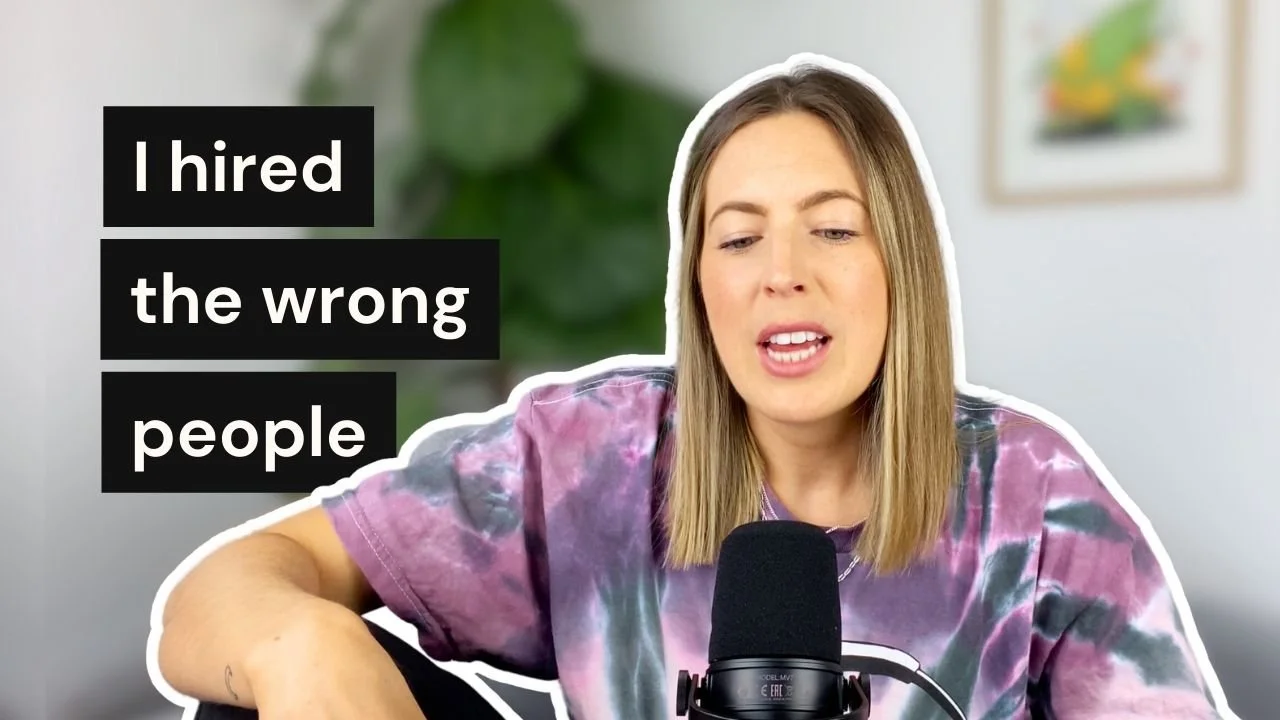
Lesson 1: Hiring Great People Takes Time. A lot of Time.
After having 2 hiring flops this year, I was forced to learn a harsh lesson. Hiring great people is a huge time commitment. And if you try to bypass that huge process, you'll pay the price (literally).
I learned there are two parts to hiring great people.
they have to be the right kind of person.
they have to be right for the role.
First off, everyone's definition of the 'right' team member is different—what works well for you may not be the same for me.
Second, to find the right person for the role, you first need to know exactly what that role is.
This year, I made some big mistakes by hiring too quickly. It literally cost me thousands of dollars and even more in the hours I spent onboarding and training these people.
One mistake involved hiring the right type of person, but she wasn’t the right fit for the role I needed. The other had all the right qualifications on paper but wasn’t the right type of person. Yikes.
(And, yes, this definitely was NOT the first time I’ve made this mistake, but for some reason, it really hit home this year. Lesson finally learned!)
So, how do you make sure you hire the perfect person? Start by creating a strong plan before you even think about hiring. This is so important, and something I’ve failed to do well many times. In this plan, you need to figure out:
A. What will the role look like:
Why are you hiring? What do you want this person to fulfill?
Start by writing a comprehensive role outline and list the tasks they’ll be responsible for.
Get super clear on how the role will fit into your business. Do you need to rearrange other team members' roles to make room for this new hire?
Consider creating a clear team org chart—who’s responsible for what, who will report to whom, etc.
Once you sit down and plan the role, you might realize you don’t actually need to hire anyone after all, or that the role is quite different from what you initially thought.
I could have completely avoided hiring the wrong person by doing this first. A few hours of work upfront could have saved me a lot (money, time, and sanity) down the line.
That said, it’s easier said than done because you might not know exactly what the role will look like yet. But if you hire the right person, things will likely shift and adapt to suit their strengths. The key is to start somewhere—you can always adapt once you have the right person in place!
B. What type of person you need:
It's crucial to get clear on this before you start hiring. From the moment someone submits a job application, you need to be looking for these traits.
What kind of qualities do they need to excel in this role? Create a comprehensive list of what you’re looking for.
Who do you want representing your business?
What kind of personality will mesh well with you and your existing team?
Everyone is going to say they're hardworking, autonomous, perfectly skilled for the role, detail-oriented, confident—the whole package. But the reality is, they won’t be all of those things.
The interview process is a bit like detective work. If someone claims to be detail-oriented but has three spelling mistakes in their application, you can probably assume that’s not true. If they say they’re incredibly organized but email you last minute for a link to the interview (which you already sent), that’s a red flag.
Gauging their "soft skills" is less about reading their application and more about reading between the lines. This takes time, because often you have to go back and forth with the candidate to uncover these traits—it’s not always obvious in a written application.
The reality is, not everyone will have every trait you’re looking for. Those perfect candidates just don’t exist. Everyone has weaknesses—we’re all human! So, if you have a clear list of priorities for the type of person you need in this role, it’ll be easier to overlook minor mistakes if they’re excelling in other areas.
The honest, and harsh reality of all this:
It takes SO much time. Outlining the role and the type of person you need is just the tip of the iceberg.
Next comes putting together the job applications and making sure to distribute them as widely as possible to get as many applications as possible—after all, the more applicants you have, the better your chances of finding that absolute star!
Then, you’ve got to go through all those applications. We received over 300. As you can imagine, that took hours and hours.
We interviewed around 15 people, then held secondary interviews with a few more. That took hours, too—and it’s mentally draining. Meeting all these wonderful people, knowing you can only hire one of them.
And that’s just to get to the starting line. Onboarding and training the right person takes months. Even when you find the perfect fit, it’s not smooth sailing from day one. The learning curve is steep, and for a while, it feels like double the work.
But when you finally onboard that perfect person? Game-changer. Just don’t ask me if I’m ready to do it again anytime soon. Spoiler: I’m not. (But at least I know how to do it now, right?)
👉 Top 5 Challenges New Web Designers Face & How to Overcome Them
Lesson 2: Let go of Perfectionism to Scale
I’ve heard this one talked about a lot, but it finally clicked for me the last year. (Well, mostly clicked—it's still a constant battle.)
Between onboarding new team members and restructuring roles about 10 times (shout-out to Emily for holding down the fort while I navigated all of this), I didn’t have the luxury to micromanage or tweak every pixel to death.
Your team won’t do things exactly how you would—and that’s okay. Does that mean it’s worse? No. Sometimes, it’s even better!
Keep the Big Picture in Mind
I’m constantly checking in with myself. Does this really need to be checked? Am I wasting time on something that won’t even make a difference? Will anyone even notice this tiny design tweak that took me 30 minutes? I remind myself of my big-picture goals. If I’m trying to grow and scale this business, is this the best use of my time? Probably not.
It’s also holding back your team. If you’re constantly checking everything they do, they’ll never learn how to check it themselves. It’s a lose-lose!
Get Your Systems Sorted
Having strong SOPs (Standard Operating Procedures) and clear systems in place helped me step back while still feeling confident that things wouldn’t implode. We have an SOP for almost everything (we store all of our SOPs in Clickup…highly recommend!), which empowers the team to take control of their projects and quality control their own work.
I will say, though, now that I have the right people in the right roles, this has become much easier. Having team members who have proven they can follow an SOP, make decisions, and manage their own work is key to letting go. Not everyone is up for that task—even if they’ve been working with you for a long time!
Lesson 3: Some Ideas You Think are Great Will Flop—and That’s Okay!
In 2023, we put countless hours into developing our “Build Your Own” Templates—customizable Squarespace templates where users could mix and match pages, fonts, and colors to create their ideal site. It was like taking our existing template model and turning the customization dial all the way up!
It was an exciting project, but it was also ambitious. We knew from the beginning that it might be too much—too many decisions, too many options, too confusing.
And it turns out we were right! The BYO templates didn’t sell very well and honestly, they added a ton of complication to our business.
About a year after its launch, we made the call to retire it. Surprisingly, it felt right. Sure, it stung to let go of something we’d poured so much work and money into, but that’s just business. Sometimes, despite the time and resources invested, you have to acknowledge when something isn’t working and move on.
We didn’t scrap the concept entirely, though. We took what we learned and introduced add-on pages to our existing templates. This way, customers still get the core design they love, with the added flexibility to customize a bit more—without the overwhelm of too many choices. We're now more confident that this is the perfect balance between customization and simplicity.
The biggest takeaway here? If something isn’t working, don’t hold on too tightly just because it’s new or you’re emotionally invested. Trust your intuition, but know that even the best ideas can fall flat. And that’s okay. We wouldn’t have come up with our current add-on solution without going through the initial struggle.
👉 PS you can check out our beautiful add-on pages here
Yes, we probably spent more time and money on that project than we got back, but that’s the nature of business. Always try to turn your flops into lessons!
Lesson 4: Business Friends are Worth Their Weight in Gold
There’s nothing like jumping on a Zoom call and ranting about business for three hours, or sending a hectic voice note (shout-out to Paige Brunton, you are a real one!), and coming away with a doc full of game-changing advice. I’ve always known having business friends was important, but this year, it really made a huge difference.
The online business space is unique, and having friends who understand that hustle makes all the difference. This year, with all my hiring dramas, I leaned on my business buddies a lot. I shared my struggles, and they came through with advice that completely changed the game for me. I took pages of notes, and honestly, without their input, things would’ve been way, way harder.
One of the best parts about having business friends in similar industries is that it makes everything feel less competitive and more collaborative. That’s one of the reasons I love the Squarespace community—it’s supportive, not cutthroat. People genuinely root for each other. I know not every industry is like that, so I consider myself pretty lucky.
If you haven’t already, find some business friends you can talk to. And don’t just leave them in your contacts—schedule regular catch-ups, even if it’s just to chat and swap stories. You’ll learn so much more through those conversations than you would on your own. Some of the biggest breakthroughs I’ve had in my business have come from those casual chats with business friends.
👉 The Reality of Starting a Template Shop: What to Expect with Expert Paige Brunton
Thank you, Next!
Each of these lessons has made me and my business better overall. So, as we roll into another year, I’m ready (ish) for whatever lessons come next, because I know they’re going to force me and the business to grow to the next level.
And if you’re still reading this, I hope my woes help you avoid a few bumps of your own. Let’s toast to growth, mistakes, and the lessons that come with both. 🥂
If you loved that post, and want more biz tips? 👇
How to Attract Clients and Grow your Business on Instagram: A Guide for 2025
How to Stand Out as a Web Designer in a Crowded Market
How we sold over 5000 Squarespace Templates: Our best Template selling tips
How to get more website design clients - with industry expert Paige Brunton
If you liked this post, Pin it to Pinterest! 👇🏻